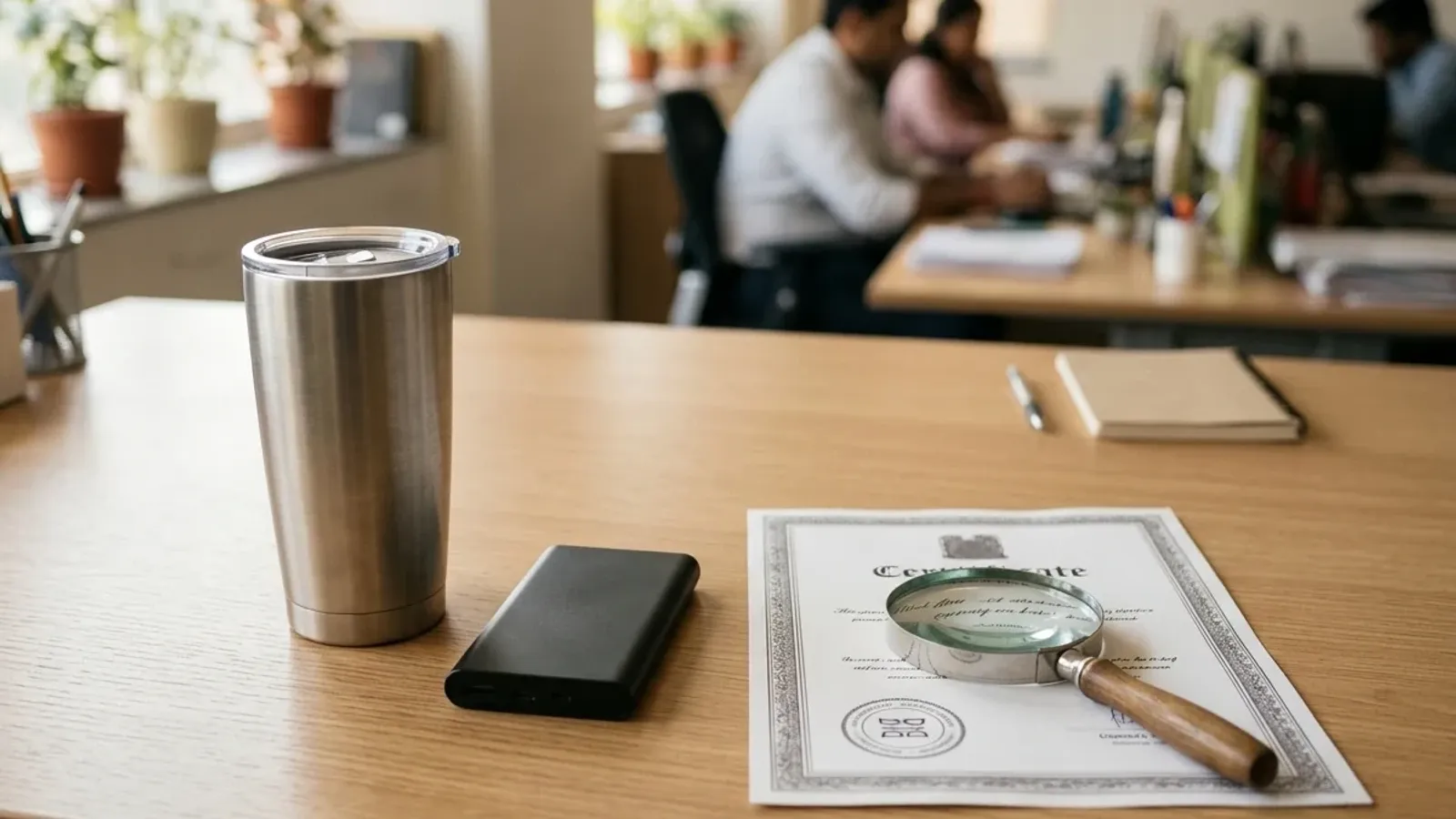
The tumblers were selling. A home and kitchen brand we work with had big insulated steel tumblers in three sizes, 450 ml, 900 ml and 1,200 ml, and they were doing well.
Amazon had been asking for their BIS paperwork since last year. In April 2026, it blocked the listings.
The tumblers hadn’t changed. Amazon had simply stopped waiting for a mark they didn’t carry: BIS certification.
The rule was older than the block
Insulated steel bottles and flasks have needed BIS certification for a while now. The order that covers them, the Insulated Flask, Bottles and Containers for Domestic Use (Quality Control) Order, has applied since June 2024 for most makers, September 2024 for small ones and December 2024 for micro ones. It names two standards that matter here: IS 17526 for vacuum-insulated steel flasks and bottles, and IS 17790 for ones with foam or another insulating material between the walls. Anything it covers must carry the ISI mark, under a BIS licence, on each bottle.
What changed was Amazon’s patience. It had been asking our client for the documents since last year, and our client wasn’t the only one being asked. Another seller wrote on Amazon’s forum in January 2026 that a tumbler had been flagged under its rules for hot flasks and bottles 48 hours after listing, with documents due by March. By June, an Amazon staff member said it plainly on the same thread: insulated tumblers fall under its listing compliance policy, which means BIS.
No law names tumblers. Amazon treats insulated ones as hot flasks and bottles, and on Amazon, that’s the reading that decides whether your listing stays up.
Plain steel utensils have a BIS order of their own too, phased in between October 2025 and April 2026.
Two sales, then a question
The power banks got caught much faster. An electronics brand we work with had shipped them into Amazon’s warehouses without BIS registration, and at first nothing stopped them. Then the first one or two units sold, and Amazon asked for the certificate.
Power banks have needed BIS registration since 2015, under a different scheme from the tumblers: the Compulsory Registration Scheme, which covers most electronics. There’s no factory inspection. A lab recognised by BIS tests the product, the manufacturer registers it, and it gets an R-number.
In our experience, it isn’t quick. BIS’s own target is 20 working days once the application is in. But the lab comes first: you have 60 days to get a sample to the lab after raising a test request, and up to 90 days to apply once its report is out. If Amazon’s request lands before you’ve started, you’re already behind.
Then there’s the number. A BIS registration lists every model number it covers, and Amazon checks the model number and brand on your listing against it. Its own policy says the two must match to show that the product certified is the product listed. So if the model number you gave BIS isn’t the one on your Amazon listing (many sellers loosely call it the SKU), Amazon won’t accept the certificate, even for an identical product. Our rule now is simple. Give BIS exactly the model number that’s on your listing, or fix the listing before you apply.
Colours are the next trap. Our client registered each colour of its power banks separately. You may not have to: BIS’s newest guidance for power banks lets versions that differ only in colour share a series, tested once. What you can’t skip is the model number. Every model number you sell has to be on the registration, and Amazon matches model number and brand, so if your white and your black carry different model numbers, both must be on it.
And the pictures. Amazon wants images that show the product being sold is the one that was tested, with the BIS mark, the registration number, the model number and the maker’s details all visible. In our experience, it compares the product pictures in the BIS paperwork with the photos on your listing.
One more trap if you sell under your own brand: the registration has to be in your brand’s name. Amazon’s staff have said on its forum that a factory’s certificate plus an authorisation letter isn’t enough for white-label chargers and power banks.
Two routes, one owner
Online sellers mostly meet BIS in one of two ways. ISI, under Scheme-I, is a licence. BIS assesses the factory, the product is tested, and the licence number reads CM/L followed by digits. That’s the tumblers. CRS, under Scheme-II, is a registration with no site visit and an R-number. That’s the power banks, along with LED lamps, adaptors, smart watches, wireless earphones and Bluetooth speakers. Toys, pressure cookers, helmets and footwear have their own orders too. By BIS’s count in October 2025, 773 products under 191 orders needed certification.
Either way, the licence belongs to the manufacturer, not to the importer or the seller. It’s tied to one factory, one brand and a list of model numbers. If you import, the overseas factory holds it. For ISI products that means BIS’s foreign manufacturers’ scheme, which takes about six months on average. For CRS products the factory registers with an authorised Indian representative, often the brand owner here. And customs now checks CRS registration numbers before it clears goods.
The fees are rarely the hard part. Under the 2026 rules, a CRS registration carries a ₹25,000 processing fee each year plus small application and licence fees, with big discounts for micro and small firms until May 2029. Adding models costs ₹30,000 an application. All of it is plus GST.
How Amazon checks
Amazon’s position is that complying is your job. Since 30 September 2024, a product it flags needs its documents submitted and approved before it can be listed at all. Listings that were already live get a dated request, product by product, in Account Health under product policy compliance. Miss the date and the listing can come down, and your selling privileges can go with it.
If the stock is in Amazon’s warehouse when that happens, it’s stranded: it sits there and can’t sell. Leave it unresolved and Amazon removes it 30 days after its stranded-inventory email. Where a listing was pulled in a safety review, sending documents afterwards doesn’t guarantee it comes back.
Amazon isn’t being difficult for the sake of it. The pressure comes from the government. In March 2025, the government announced BIS raids on Amazon and Flipkart warehouses, including 534 uncertified vacuum-insulated steel bottles seized at a Flipkart warehouse, and notices to Amazon, Flipkart, Meesho, Myntra and BigBasket. In a Lok Sabha answer this February, the government said BIS had searched 22 e-commerce warehouses since 2024-25: 14 of Amazon’s, 7 of Flipkart’s and one of Blinkit’s. The law behind it allows up to two years in prison, or fines that start at ₹2 lakh and can reach ten times the value of the goods.
Before you list, or import
- Find out whether your product needs BIS, and which kind: an ISI licence or a CRS registration.
- Check the manufacturer’s licence yourself. BIS’s free BIS Care app verifies ISI licences and CRS R-numbers.
- Make sure the licence names your brand and every model number you’ll sell, and add new models before they ship, not after.
- Put the same model number and brand on your listing, exactly as they appear on the certificate.
- Mark the product and the pack: the ISI mark with its CM/L number, or the Standard Mark with the IS number and R-number, and www.bis.gov.in.
- Make sure your listing images show the mark, the licence or registration number, the model and the maker’s details.
- Importing? Settle it before the goods leave the factory. Customs checks too.
BIS is one line on our shipment checklist. It’s the one line you can’t fix with a sticker at the warehouse.
Where we come in
No agency can get you BIS. The product has to be tested by a lab recognised by BIS, and BIS grants the licence to the manufacturer. Anyone promising you a shortcut is selling you something else.
What we can do is sit on your side of Amazon’s compliance requests, because we’ve been there before. We’ve seen listings blocked and stock stranded, so we know where it usually goes wrong: a model number that doesn’t quite match the listing, or a colour that was never added to the registration. When we manage your account, we check your listings against your certificate before Amazon does, and we work through the compliance request with you when it comes. (For more on getting a brand onto Amazon properly, start with our guide to selling your brand on Amazon India.)
The power banks got their question after two sales. The tumblers got months of reminders, and then a block. Ask it yourself, before the first sale: does this product need BIS, and does the certificate say exactly what my listing says?