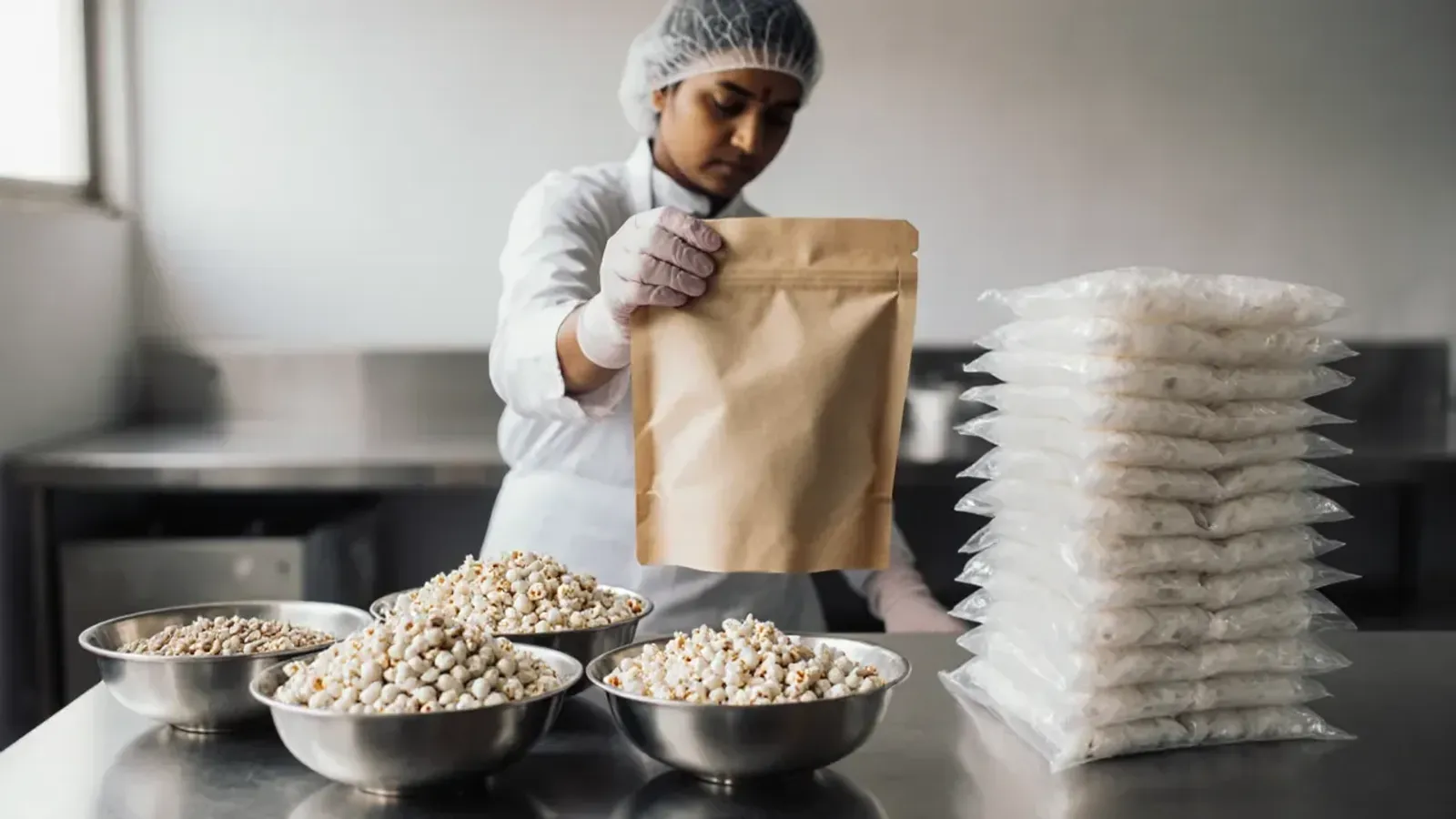
Under FSSAI’s rules, a food can’t be called “healthy”, and FSSAI has told food businesses to stop using “100%” on their packs. Say you make roasted makhana in Indore, and you want it on Blinkit, Zepto and Swiggy Instamart. Your new packs say “100% Natural” and “Healthy Snack” on the front in big letters, and you are about to print 10,000 of them.
Stop the print run. Claims like these are exactly what regulators are checking on quick-commerce apps right now.
This guide covers what a food brand needs before selling on Blinkit, Zepto and Instamart: the right licence, what the pack and listing must show, shelf life, and the claims that get products pulled.
What happened on 23 September
On 23 September 2026, FSSAI said it had started penal action against five platforms: Amazon, Flipkart, Swiggy Instamart, BigBasket and Zepto. As Business Standard reported, the problems were misleading claims and product information. FSSAI flagged a dried-fruit snack sold on all five platforms, and three products from a dairy brand. It also found a poisonous plant, datura, being sold as food. FSSAI announced this on social media and has not said what the penalties are.
State food departments are checking too. In August 2026, Maharashtra’s Food and Drug Administration inspected 86 places that deliver food through online platforms. It suspended 14 licences, five of them linked to Blinkit and five to Zepto, and issued 60 notices. Inspectors found a chiller room running warmer than allowed, and food kept past its use-by date.
For a brand, the lesson is simple. FSSAI’s rules ask platforms to remove any food listing that doesn’t follow the law, straight away. If your pack or listing is wrong, your product is the one that comes down.
The licence you need
FSSAI changed its licence limits on 1 April 2026. They now depend on your yearly turnover:
| Yearly turnover | What you need |
|---|---|
| Up to ₹1.5 crore | FSSAI registration |
| ₹1.5 crore to ₹50 crore | State licence |
| Above ₹50 crore | Central licence |
Before this change, registration covered only businesses with turnover up to ₹12 lakh. So many small brands that needed a state licence earlier now need only a registration. If you already hold a licence, you can move to the new category on FSSAI’s FoSCoS portal for free, and keep your licence number. FSSAI’s order on the new limits has the details.
Licences no longer expire. But you still have to pay the yearly fee and file the annual return. If you miss either one, your licence is treated as suspended, and selling during that time breaks the law.
Each platform asks for it in its own way. Blinkit wants a valid FSSAI licence for the location you ship from, and an “FSSAI image” for every food product: a photo of the pack showing your licence number. Zepto’s public onboarding list asks for your PAN card, GST certificate, a cancelled cheque, a copy of the authorised signatory’s signature, and your trademark certificate or authorisation letter. Instamart doesn’t publish a list. But FSSAI’s rules apply on every platform, whatever the platform asks for.
One question FSSAI hasn’t answered clearly is whether a brand that only sells its stock to a platform, as brands do on Blinkit, needs a special central licence for e-commerce. Ask your food licensing consultant about your exact set-up.
What your pack and listing must show
The pack comes first. Every food pack needs:
- The FSSAI logo and the brand owner’s licence number, plus the manufacturer’s number if it is different
- The veg mark (a green filled circle in a green square) or the non-veg mark (a brown filled triangle in a brown square), close to the product name on the front
- Allergens, listed as “Contains”, for example milk, nuts, soy or gluten
- Nutrition information per 100 g or 100 ml
- The date of manufacture or packing, the expiry or use-by date, and a batch number
Then the listing. FSSAI wants all the mandatory label details shown to the buyer before they pay, except the batch number and dates. The listing must include a clear photo of the front of the pack, and your FSSAI licence number must be visible. Most importantly, every claim on the listing must match what is printed on the pack. FSSAI’s advisory to e-commerce food businesses says this plainly.
Our warehouse shipment checklist covers the other labels that marketplace warehouses check, like MRP and barcodes.
Shelf life: two different checks
There are two separate shelf-life rules, and they apply at different points.
FSSAI’s rule applies when the food reaches the customer. It must still have at least 30% of its shelf life left, or 45 days before expiry.
Blinkit’s rule applies earlier, when your stock reaches its warehouse. Perishable food must have 70% to 75% of its shelf life left to be accepted. So plan your production so that stock reaches the warehouse fresh. Our guides to selling on Blinkit and the documents Blinkit asks for cover the rest of the process.
Claims that get listings pulled
FSSAI’s rules on claims are strict, and many packs break them without meaning to:
- “Natural” is only for single foods. A mix of ingredients can say “made from natural ingredients”.
- “Fresh” is only for food that has at most been washed, peeled, chilled, trimmed or cut.
- “Pure” is only for a single-ingredient food with nothing added.
- “Home-made” and “home cooked” are not allowed.
- A food can’t be called “healthy”, and it can’t claim to prevent, treat or cure any disease.
- “High protein” needs at least 20% of the daily recommended protein per 100 g (for solid food).
FSSAI’s advisory of May 2025 asks food businesses to stop using “100%” on labels, packs and promotions. In August 2026, FSSAI stopped a large FMCG company from selling several products labelled “100% natural” and “100% pure”. FSSAI has also said that “ORS” can’t be used in the name of a food product at all.
If your brand name itself uses a word like “natural”, “fresh” or “pure” in a way that could mislead buyers, FSSAI asks for a line on the front of the pack saying it is only a brand name and doesn’t describe the product.
The penalties are real. Misbranded food can cost up to ₹3 lakh, and a misleading advertisement up to ₹10 lakh. Selling without the licence you need can mean up to six months in prison and a fine of up to ₹5 lakh.
One rule is not in force yet: warning labels on the front of packs for food high in sugar, salt or fat. The Supreme Court reserved its order on this on 28 September 2026. Until the court decides, it is not required. We will update this article when the court decides.
Where we come in
We design food labels and packs that carry every detail FSSAI asks for, with the claims written so they stay within the rules. We also onboard food brands on Blinkit, Zepto and Instamart with the documents each platform asks for, and check that each listing matches the pack. We don’t handle FSSAI licence applications; a food licensing consultant can help you with those. The pack is where it starts, and that is our packaging design work.
Back to the makhana. Take “100% Natural” and “Healthy Snack” off the pack before the first print run, not after the first notice.